
Preface
I graduated not too long ago in 2024, and it felt like new grads around me were venturing into a market that was being pulled from underneath them. Post-COVID layoffs, the looming promise of omni models like GPT-4o, and a huge disconnect between what the last vestiges of our education had prepared us for and the state of the industry we were about to enter.
In the years since, we’ve seen some of this augury play out and some of it fall through the cracks. For one, the ‘reckoning’ has not actually arrived yet as people predicted (although estimates still put us squarely in the timeline for this). In other news, we’re in a world where graduates feel like they’re entering a workforce that no longer values them and what they can bring to the table. Especially if what they bring to the table is largely commensurate with the capabilities of a $100 Claude Max subscription.
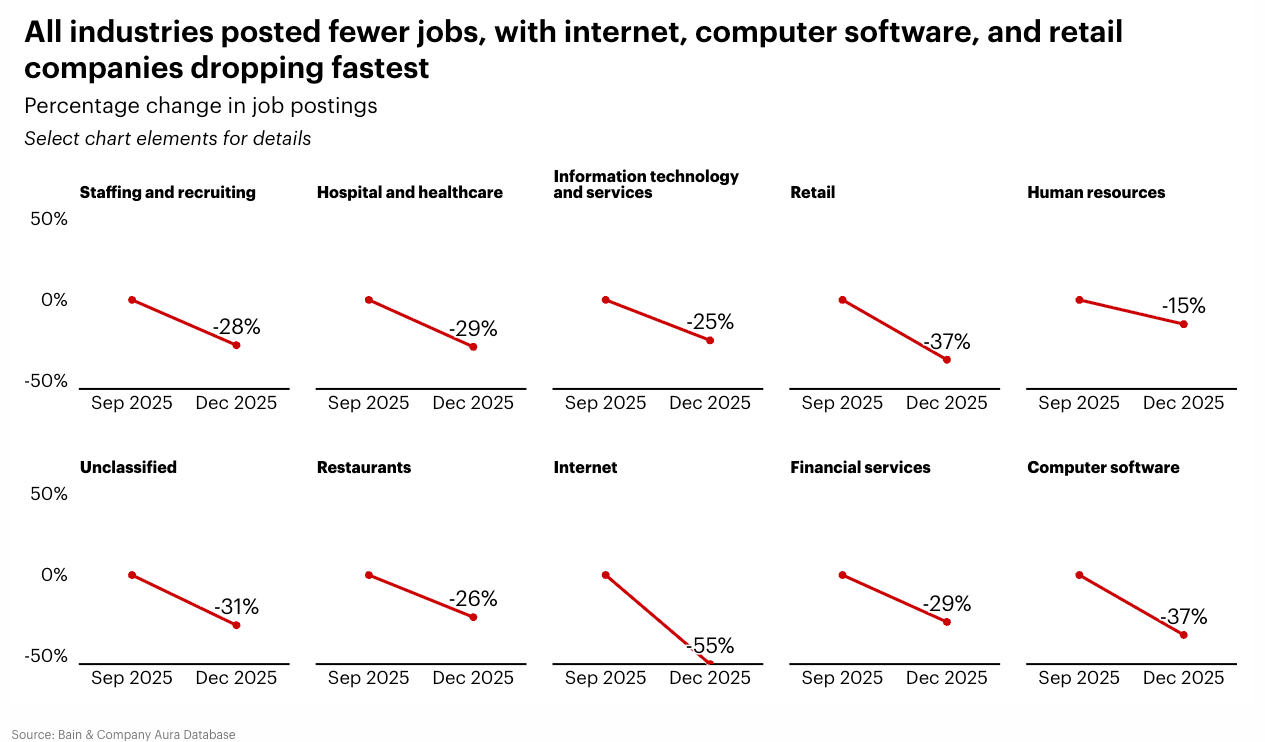
Source: Bain & Company Aura Database
I want to take a second to provide some responses to questions that may be on the minds of so many new grads in this major milestone of their lives. This is going to be couched in the context of what I studied (CS and CS-adjacent fields), but I’m sure a lot of this can and will extend to graduates in other disciplines looking for other types of roles.
How do I ‘get ahead’ if no one’s giving me a shot?
Briefly on this concept of ‘getting ahead’, I think many of us have naturally absorbed this belief that we only succeed at the expense of someone else. I don’t appreciate this framing of the world as a coliseum in which we’re constantly being pitted against each other to measure ourselves up to an ideal of someone who’s ‘better’ than the next person.
This is a dangerous idea and ignores the fundamental truth that your talents, gifts and abilities are not by any means reduced because another person or $0.048 of Claude flibbertigibbeting could do it as well or better than you did. Someone else’s success never eliminates your own. Life and the world at large is not a zero-sum game.
AI does not change that.
Experience has also never been singularly defined by a job or formal position. Now more than ever, you have the chance to build your own experience by working on things you previously thought you were unlikely to be exposed to outside a formal learning environment (be it through school or a job). You can’t entirely replace the value of the human connection and mentorship you get in these institutions or internships/jobs, but AI can bridge a lot of these gaps.
What’s the point of learning “things” (broadly) if AI can do these much better and faster than me
Asking this question is like asking if there’s still value in learning arithmetic because calculators exist and they do math much faster than you can. It’s not so much who’s better at doing it, but knowing how to do it and getting enough repetitions with certain concepts enables you to move more fluidly through challenges that require you to apply it.
The reduced friction of writing code because you actually understand the architecture of software, the CRUD operations, what client-side rendering is and maybe more esoteric things like how TCP/IP works etc. is an insanely underrated superpower in a world where fewer people are bothering to truly apply themselves to these things anymore.
There are some caveats here. I wouldn’t index on the specifics of a programming language or syntax anymore. That used to be the only means we had to building code. Now we have tools that generate what is generally the best code for a given task. You really want to fundamentally understand the scaffolding around the task, so you can catch the potential assumptions it’s making and poor design decisions that may eventually compound and morph into a sloppy mess.
Learn the why. And just enough of the how.
Where do I learn how to work with these tools?
Projects projects projects. Build whatever you want. Build anything you want. Like I said above, the prevalence of LLMs now means a unit of engineering time has almost become negligible compared to what it was just 2 years ago. If you wanted to build a new blog (like I did here), go do that! If you wanted to learn how to build a compiler in C, I’m sure AI can teach you that, much more quickly than reading through pages of documentation and developer guides that quite frankly never got to the point where they were truly intuitive and readable for most humans anyway.
In the process of building with AI you’re going to realize its faults and its strengths. It does A LOT of things great. That doesn’t mean it does everything right. Figuring out where LLMs fail or more specifically where you fail when using AI tools will arm you with a better sense of how to wield these to build the things that many others struggle with.
“For the things we have to learn before we can do them, we learn by doing them.” - Aristotle, The Nicomachean Ethics
If the above still holds true (and I firmly believe it does) you’ll figure out a lot of things just by doing. There’s no substitute for this.
One thing I would advise you to do, however, is to go slow while learning. When you don’t actually know how to do something, you’re unlikely to know if what the LLM is suggesting is actually right. You can learn by prompting it more tightly. Ask questions like
-
“Is there a more elegant solution to this?”
-
“Knowing what you know now about the state of our codebase, what might you change to make things more performant/scalable/maintainable?”
-
“Can you apply basic design principles like YAGNI, KISS and DRY to what I asked you to build. What would those changes look like?”
Do your own googling. Paste links to updated documentation or consider using MCPs like Context7 to get the most reliable code/API references. Reading the responses of an LLM to targeted questions will slowly help you develop your own sense of what well-written software looks like.
I would suggest more tools, tips and harnesses here but generally this space moves so quickly that any definitive recommendations are likely to become obsolete soon so I’d much rather steer you towards generally starting with the basics than trying to index too heavily on an optimal setup here.
What jobs will still be available for me?
I don’t believe Enterprise SaaS tools are going to be eliminated en masse. Yes you could probably vibe code an alternative to Salesforce or Hubspot that gets you 80% of the CRM capability you need but realistically, as long as we don’t have self-healing AI systems that are able to triage maintenance requests, escalate tickets, maintain existing software and proactively squash bugs independently 24/7, people are still going to pay for a 3rd party vendor to deal with these things for them. And we still need humans to orchestrate a lot of this. I don’t know if that’s going to change in the near future, and we can never truly write it off, but for now there’s still a need for engineers to do the work that AI can’t definitively do.
I also anecdotally am seeing a lot of demand at the other end of the spectrum with AI-native startups looking to hire aggressively and often, willing to bet on new grads who can/have demonstrated the ability to wield AI to bridge the gaps between them and what many would consider the output of senior devs.
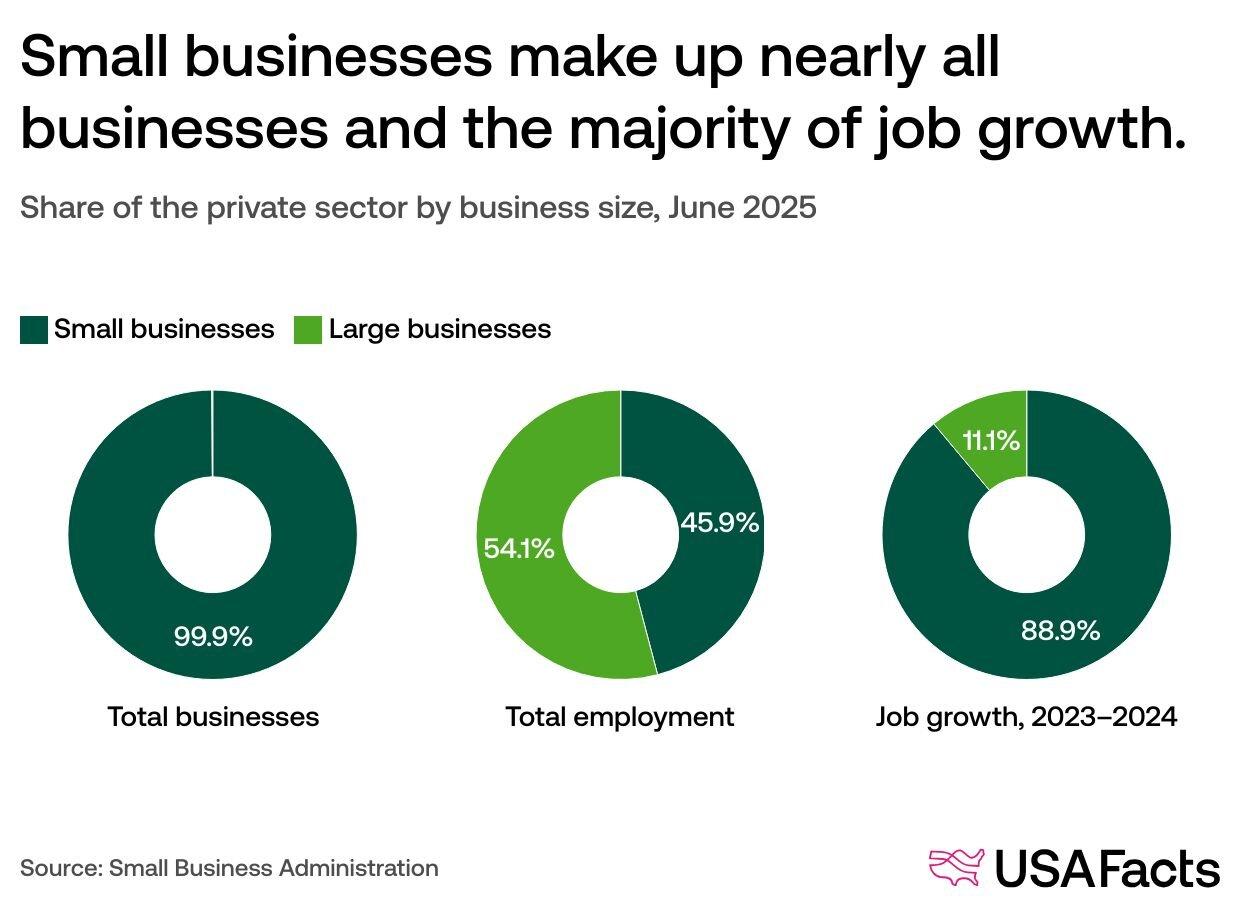
Source: usafacts.org
I think it’s important to recognize that most of us actually have a large number of available options. We just don’t perceive certain types of work as ‘viable’ because it pays less than a benchmark salary you have in your head, or carries less than a certain level of prestige. There’s an implicit assumption that if you studied some pragmatic/vocational white-collar major that you can only take a job paying you somewhere at least in the low six-figure range. When you deconstruct that belief and your personal ego, you’ll realize there are a plethora of jobs in that 60-90k range that will provide you a foot through the door and an amazing foundation to build your skills on top of.
They may not be the shiniest and brightest jobs out there, but they’ll most definitely start giving you the foundations to then build the rest of your career on top of.
Should I stay in school and get a Master’s or a PhD?
This one’s a little subjective. I’d say there’s actually more (and less) value in a postgrad degree these days than in the years prior. A lot of what you practically need to know about harnessing AI are things you’ll get just by simply going out and building things.
But there’s a growing field of opportunity available at the cutting edge of LLM and AI research that requires more and more brilliant minds to be dedicated towards the science behind quantizing LLMs or building better tooling around LLMs
Take a look at the landscape of Neolabs (aptly named) and you’ll see opportunities to work in academic environments but be compensated like you would in industry. Figuring out how to increase creativity in models, generate net new knowledge, build self-correcting and self-healing systems and most importantly, learn how to build the guardrails around AI Safety so we aren’t all consumed by a 6th mass extinction event we brought upon ourselves.
These are important problems to solve and fortunately or unfortunately, a lot of this work is still gatekept behind academic qualifications
What about starting my own company?
I’m actually a huge advocate against doing this right out of college. That’s not to say that I don’t believe people are capable of starting great companies at a young age (or in the era of AI). I also don’t think that this is necessarily a ‘bad’ path but in the interest of building a fruitful forty-year career, I think most people are generally going to benefit more from building for the sake of learning and not to muddle their learning with the daily swings of running a company (burn rate, revenue, PMF, GTM etc.)
There’s so much noise in a startup that you’re going to realize a lot of your life will be consumed by this. Starting a company is bloody difficult and don’t let anyone sweet talk you into believing anything of the contrary. Do it if you feel a calling to solve a problem. And constantly ask yourself, why am I the right person to be doing this and why is this the right time to be doing this. If you don’t have great answers to those questions yet, you’re better off finding the answers to those questions first through any other means necessary first.
Starting a company should be the path you take when you’ve necessarily exhausted all other options.
Closing thoughts
I don’t want to give off the sense that any of these things are easy to think about or to act upon. But initiative counts for so much more today than in any other time in modern history.
Live lightly and work deeply. There’s a lot more to your potential career and more importantly, your life, than the doomsday heralds will have you believe.
Venture out and be brave!
— DR